
Invention of the Internet!
A Historic revolution in the communication of the human race
The Internet's origin goes back to the 1950s and has touched so many lives since then. During the Gulf war, a crisis arose to be better informed, and the U.S. Department of Defense decided to fund ARPANET for their research in this area. At that time, ARPANET used packet switching allowing multiple computers to communicate with each other on a single network. Years of study and work in this field led to the first message delivered from a "node to node" communication from one computer to another by ARPAnet on October 29, 1969.
During the 1950s, telephone exchange worked differently where a middleman had to connect the two callers, and when the connection path was broken, the call was lost. Damaged communication and security became a national concern during the Soviet Nuclear attacks in the early 60s. The telephone exchange wanted to analyze and improve its operations to resolve this issue. Dr. Paul Baran was hired to research around how many circuits would be required to provide a method that allows users to talk with the person on the other end of the call without being on hold for too long. That is when a notion occurred called the Hot potato routing, which meant that the message finds its path and reaches the destination even if a part of the network was destroyed.
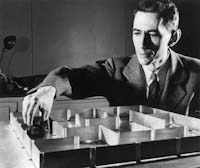
To achieve this, Baran was inspired by the 'mice in a maze' concept, like the mouse finds its way through the maze similarly, information must find its way through the network to reach the destination. Next, the message was broken into smaller 'packets.' Each packet had a 'from' and a 'to' address. These packets were allowed to take their own paths in the network based on the availability from one node to another, just like a post office. By 1962 there was a great deal of theory that showed a network could be built based on this packet switching mechanism, but it had to wait seven years to be implemented in 1969.
The first Computer network came into life by Bob Taylor, an ARPAnet scientist. The new big idea in 1966 was 'Time sharing' Bob Taylor needed a separate terminal to login into numerous time-sharing terminals at research centers across the country. He knew that a single terminal could suffice if all the computers were on a shared network. He was allocated 1 million$ by ARPAnet to bring this theory to life that changed the entire world 20 years ago, which nobody had anticipated. Bob appointed Dr. Lawrence Roberts at MIT to build this network. At that time, he was trying to connect large mainframe computers with each other, which was a problem due to the discrepancy in the properties of the computer. Then came the idea to connect each of these large computers to respective mini- computers to form a network; this way, one would have to deal with just the mini- computer to connect. This also brought in a lot of support from other universities as by connecting with the minicomputers, their private projects would not be disturbed on the main computer. Roberts had the theory on paper, but the telephone companies did not believe in it, so someone else had to build it.
In 1968, Roberts finalized the engineers to bring his research into life by ARPAnet. It was going to be based upon Interface message Processor called the Imps and Packet switching. However, the giants of communication and computers refused to fund the project by declaring it will not be successful. BBN company was willing to try what ARPAnet has envisioned and won the contract headed by Frank Heart in 1969. UCLA and ARPAnet were working under a deadline to achieve this. Dr. Stephen Crocker, a graduate student, worked on the code to join the UCLA computers to the first IMP, which would become the ARPAnet. Since each computer was different, there had to be a common language that could speak to all.
On Sep 1969, the first piece of hardware used to define this computer network arrived at UCLA. By the end of the year, all four nodes were able to communicate. This success was a steppingstone for the technology. Had this failed, the computer network theory could be abandoned by everyone. In 1971, the ARPA net had 18 mainframe computers hooked into the network; Bob Metcalfe connected MIT computers to this network and sent packets.
The computer network connection created its first killer application, the 'Email.' Raymond Tomlinson, on a keystroke, gave the whole world the new icon for the information edge '@' Email (Electronic mail) is a technique of exchanging messages between individuals using electronic devices. Initially, the users could only send messages to users of the same computer. They needed the author of the email and the recipient to be online simultaneously, which was similar to instant messaging. Ray Tomlinson in 1971, developed the first system able to send email between users on different hosts across the ARPANET. This idea took over the entire world.
The brilliance of the Internet's design is that it is built with an open architecture. It laid a foundation for many applications and possibilities. Anybody from a college student to a company executive was allowed to code and give suggestions and share information. The rate of evolution on Internet technology reached heights simply because so many could contribute to it. The first international conference took place in 1972, where ARPAnet invited everybody who had an application worth showcasing over the Internet, and what they found was 19 more new credible applications into their application bucket of 25. However, during the demonstration, the IMP crashed, and the AT&T executives were amused. Soon other networks were invented like LANs (Local area networks) and WANs (Wide area networks). But each network was different in its design and hard to connect. In 1973, a set of rules were invented called the TCP/IP protocol (Gateway), which, if followed by each network, could communicate across networks.
Finally, in 1983, after ten years, PCP IP was marked down to be the common gateway for every network on the Internet to connect to and convey information. Until now, the Internet was only open to the government and its related associations, but that would change soon. This was a political decision to be made which would bring the Internet into everyone's home and office. Along came a high rate of inventions in the devices and hardware area that brought the mainframe computers to the size of a desktop PC like the silicon chip, high-speed modem, and a mouse.
In June 1992, Congress passed the bill to take the Internet from the exclusive hands of the government and open it to the public. After this bill, so many new users with amazing ideas over the Internet stimulated for commercial and personal usage; however, the major issue was to search for this vast pool of information. The software was needed that could follow the threads of all this knowledge across the world, find it, and convey it to the user. Tim Berners Lee from the CERN research institute named this software as the World Wide Web. WWW gave the computer technology a revolutionary wave beyond file transfers and emails. The World Wide Web was made more accessible by another software called the 'Netscape' browser, which enabled the internet web pages with more functionalities like scroll bars, button clicks and made it more user friendly. Post this breakthrough application 'Browser' by the end of 1993; the web grew by 341,000%.
The group of netizens around the globe turned the Internet into a whole new world of possibilities just by few clicks and keystrokes for business, games, dating, emails. By now, the www and @ were the symbols of the information edge. The Internet was still under construction; the future would be to bring in the voice and videos in communication. Researchers in the 21st century anticipated that the internet revolution would continue to grow and bring communication across the world to another level.